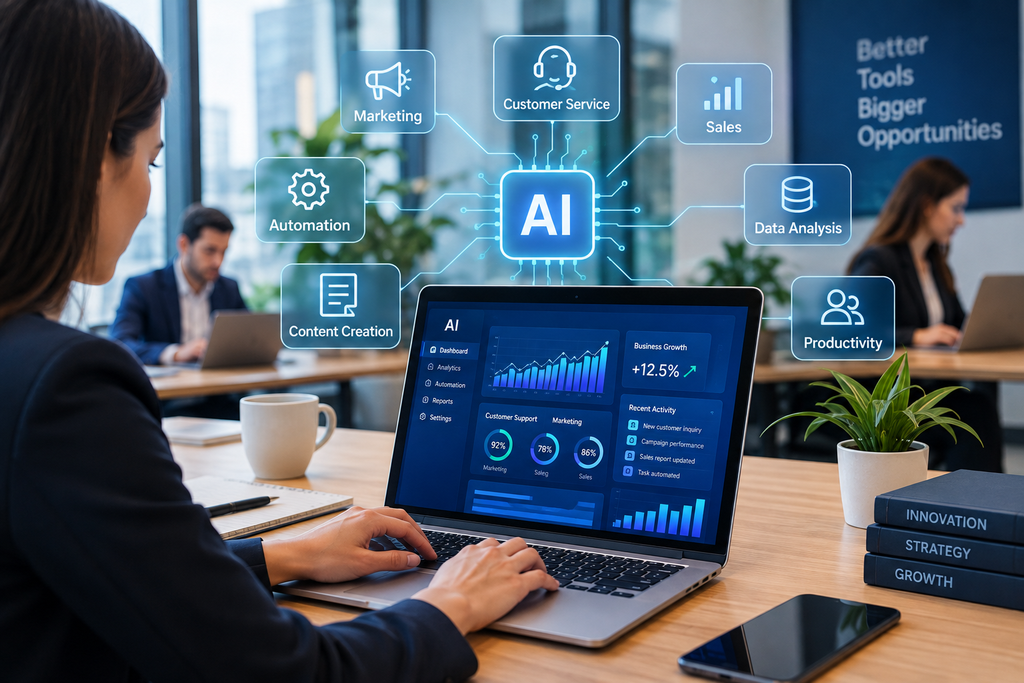
Artificial intelligence is no longer something only large technology companies use. Today, businesses of all sizes are using AI to save time, understand customers, improve marketing, and handle everyday tasks more efficiently. Knowing how businesses use AI can help business owners find practical ways to use this technology without making their work more complicated.
AI for Everyday Business Tasks:
One of the simplest ways businesses use AI is to handle repetitive work. Employees often spend a lot of time writing emails, organizing information, creating documents, summarizing meetings, and completing other routine tasks.
AI can help with many of these activities. Instead of starting everything from scratch, employees can use AI to create a first draft, organize information, or summarize a long document. The employee can then review the result and make any necessary changes.
This can save valuable time, especially for small teams where employees have to manage several responsibilities at once.
AI for Customer Service:
Good customer service is important for almost every business. Customers expect quick answers, but a company may not always have someone available to respond immediately.
AI chatbots and virtual assistants can help answer common questions, provide basic information, and guide customers toward the right service or product. They can also handle simple requests outside normal business hours.
Human employees are still important for complicated problems, but AI can take care of many basic questions and allow support teams to focus on issues that need personal attention.
AI in Marketing:
Marketing is another area where AI is becoming increasingly useful. Businesses can use AI to come up with content ideas, create drafts, analyze campaigns, and better understand their audiences.
For example, a small business owner could use AI to brainstorm social media posts or create different versions of an advertisement. A marketing team could also use AI to analyze customer behavior and identify patterns in campaign performance.
The goal is not simply to produce more content. Good businesses still need a clear message, a strong brand voice, and human creativity.
AI for Business Data:
Businesses generate a huge amount of data every day. This can include sales numbers, website traffic, customer information, product performance, and marketing results.
Looking through all of this information manually can take a lot of time. AI tools can help organize data, identify patterns, and turn complicated information into easier-to-understand summaries.
This can help business owners see what is working and where there may be opportunities to improve.
AI for Sales Teams:
Sales teams can also use AI to make their daily work easier. AI can help organize leads, prepare customer information, write follow-up messages, and analyze sales activity.
For example, instead of manually going through a large list of potential customers, a business can use AI to organize the information and identify leads that may deserve more attention.
Salespeople can then spend more time speaking with customers rather than dealing with repetitive administrative work.
AI for Small Businesses:
AI can be especially useful for small businesses because they often have limited staff and resources.
A business owner may have to manage marketing, customer service, emails, research, bookkeeping, and other responsibilities. AI tools can assist with some of these tasks and give the owner more time to focus on running the business.
Even simple uses, such as creating an email draft or summarizing research, can make a noticeable difference when those tasks are repeated every day.
AI for Content Creation:
Many businesses need content for websites, newsletters, social media, product descriptions, and other marketing channels.
AI can help generate ideas, create outlines, draft content, and suggest improvements. This can make the writing process faster, but businesses should always review AI-generated content before publishing it.
Human editing is important because AI may sometimes provide inaccurate information or produce writing that does not match the company’s style.
AI for Business Research:
Research can take hours when employees have to collect and organize information from different sources.
AI can help summarize information, compare ideas, organize notes, and identify important points. This can be useful when businesses are researching competitors, markets, products, or customer needs.
However, important business information should always be checked against reliable sources rather than accepted simply because an AI tool provided it.
AI for Employee Productivity:
AI can also become a useful assistant for employees. Workers can use AI to summarize meetings, prepare documents, brainstorm ideas, translate text, create presentations, and organize information.
This does not mean every task should be handed over to AI. Instead, employees can use it as a supporting tool while they remain responsible for reviewing and improving the final work.
AI and Business Automation:
Automation is one of the biggest reasons companies are interested in AI. Businesses can connect AI with other software to reduce the amount of manual work involved in certain processes.
For example, AI can help sort customer inquiries, categorize information, prepare reports, or trigger routine workflows.
When automation is carefully planned, it can make everyday operations smoother and reduce unnecessary repetitive work.
Things Businesses Should Consider Before Using AI:
AI can be useful, but it is not the right solution for every business problem. Companies should consider the cost of a tool, how accurate its results are, how customer information is handled, and whether employees need additional training.
Privacy and security are particularly important when businesses work with customer or confidential company information.
It is also a good idea to start small. Instead of introducing AI into every department at once, a business can choose one specific task, test an AI solution, and see whether it actually saves time or improves the process.
The Future of AI in Business:
AI is likely to become a normal part of business operations as more companies discover practical ways to use it. The technology will continue to change, but the basic goal will remain the same: helping people work more efficiently and make better use of their time.
The businesses that benefit from AI will not necessarily be the ones using the most tools. In many cases, the most useful approach will be choosing a few tools that solve real problems and combining them with human experience and judgment.
AI can be a powerful business assistant, but people still play an important role in creativity, communication, decision-making, and building relationships with customers.